← seggwat.com
Why SeggWat
Manifesto

Why user feedback decides whether products get better or quietly drift.

Most teams do not fail because they ship too slowly. They fail because they keep shipping the wrong thing with too little context from the people actually using the product.

In-context feedback
Screenshots + ratings + ideas
Privacy-first, dev-friendly
The SeggWat thesis

Feedback should happen inside the product, with context attached, so builders can learn faster and make fewer expensive guesses.
The core problem

Teams are overloaded with noise and still starved of signal.

Scattered

Feedback lives in email, Slack, support chats, screenshots, spreadsheets, and founder memory. Nothing is centralized enough to trust.

Out of context

Users describe a bug after leaving the page. Now the team has a vague complaint and zero clue what the person actually saw.

Biased

The loudest users dominate the roadmap while quiet frustration never gets captured, quantified, or prioritized properly.

Too late

By the time a team notices churn, refunds, or drop-off, the feedback loop already broke weeks earlier.

Why it matters

User feedback is not a nice-to-have. It is product steering.

  • It tells you what hurts, not what your backlog guessed might hurt.
  • It helps you see why adoption stalls, before churn shows up in Stripe.
  • It shows what to build next with more confidence and less guesswork.
  • It lets users feel heard, which is often the difference between loyalty and indifference.
“Without feedback, product decisions become a mix of intuition, panic, and whoever spoke last in Slack.”
What bad feedback collection costs

The real cost is not missing a comment. It is shipping expensive misunderstandings.

Wrong roadmap

Teams overbuild pet ideas, underinvest in friction, and spend weeks polishing features nobody asked for.

Slow fixes

Support has to reproduce issues manually because reports arrive without path, version, or visual evidence.

Quiet churn

Users do not always complain. Many just leave. Missing early signals means learning only after revenue drops.

Why old approaches fail

Google Forms and generic surveys collect answers. They do not collect product truth.

01

User leaves the product

Every extra click to another page kills intent and strips away context.

02

User describes from memory

You get “something is broken” instead of the exact screen, area, state, and path.

03

Team triages manually

Now someone has to chase screenshots, browser details, and duplicates across scattered tools.

Translation:

The friction of collecting feedback becomes the reason the most useful feedback never arrives.

The SeggWat answer

Capture feedback where the problem happens, with enough context to act immediately.

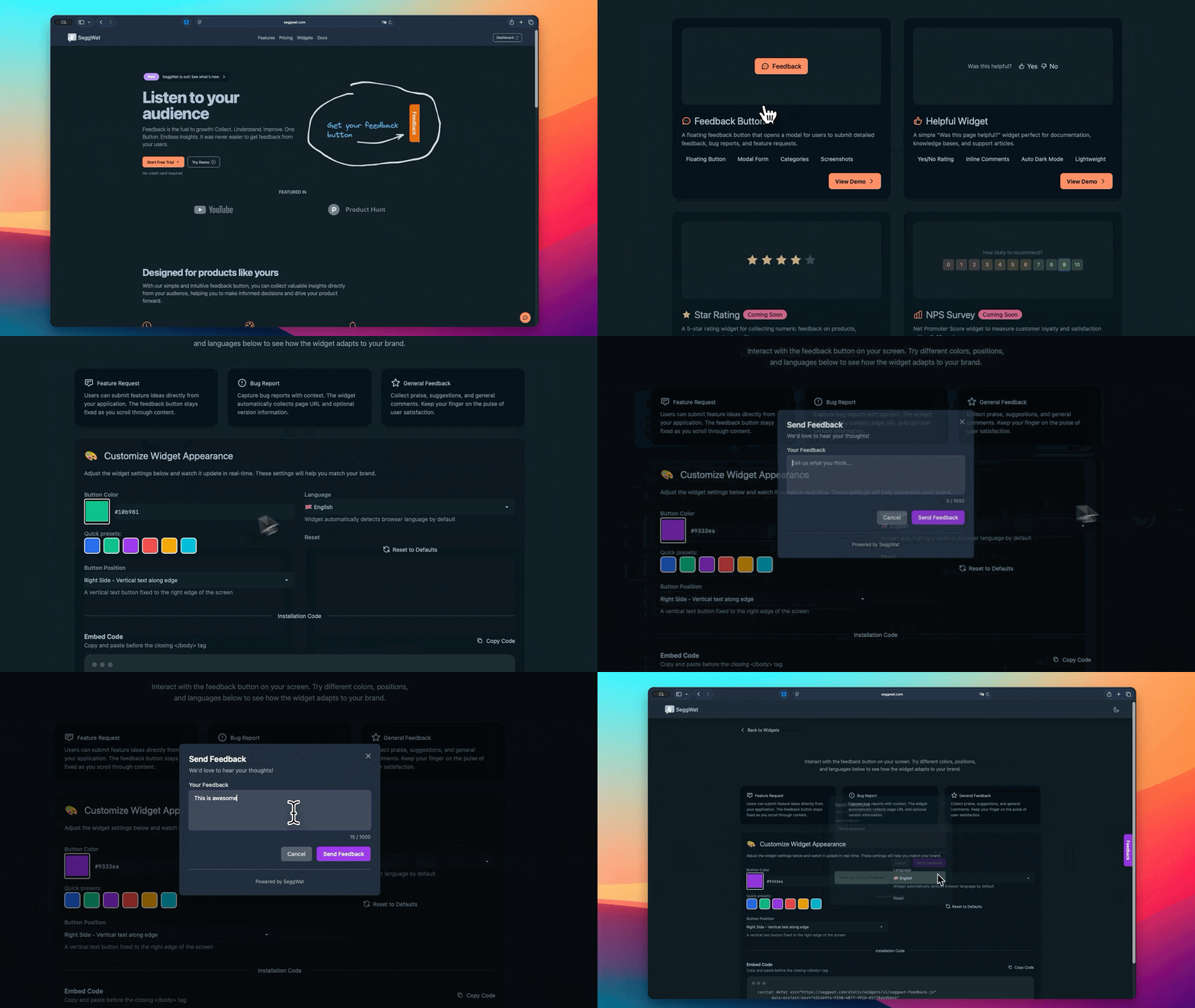
SeggWat feedback button embedded on a live page

In-context widgets

Feedback button, modal, contact, ratings, NPS, and ideas collection directly in the product instead of on a detached form.

Screenshot annotation

Users can show the exact UI issue visually, which cuts down ambiguity and back-and-forth immediately.

Feedback management + analytics

Triage, page-level insights, ratings, churn analytics, and idea lifecycle in one place instead of six tabs and a spreadsheet.

Feature voting portal
GitHub / Polar / Stripe integrations
MCP server for AI-assisted triage
Cookie-free, GDPR compliant
Who this matters for

Built for small teams who need every signal.

SeggWat fits indie hackers, solo founders, and early-stage SaaS teams who cannot afford enterprise bloat, months of setup, or privacy headaches.

  • Lean teams shipping to growing user bases
  • Modern stacks like React, Next.js, Astro, Vue, or static sites
  • Teams choosing between “too expensive” and “too primitive” feedback tools

SeggWat’s advantage

It sits in the gap between enterprise tools like Canny or UserVoice and flimsy workarounds like forms or ad-hoc chat messages.

Developer-friendly, EU-hosted, privacy-first, and broad enough to handle widgets, ratings, voting, and analytics in one system.

What good feedback changes

When the loop is tight, better products become a compounding advantage.

Faster learning

Know what users struggle with before you waste the sprint.

Smarter prioritization

Roadmaps start reflecting actual demand and repeated pain, not whoever shouted loudest.

Better retention

Users stick when issues are fixed, ideas are acknowledged, and friction gets removed early.

More trust

People are far more patient with a product when they can see the team actually listening.

Positioning

Not enterprise theater. Not generic forms. A real feedback system for builders.

Built in Rust
Engineered in Germany
Hosted in Europe
API-first + CLI + MCP
SeggWat helps teams stop guessing, start seeing, and improve products with feedback that arrives where it matters.
Get started

If your product does not have a feedback loop, it does not have a learning loop.

The question is not whether users have opinions. They do. The question is whether your product makes those opinions easy to capture, easy to understand, and easy to act on.

SeggWat makes that loop practical.

14 days free · EU-hosted · Cookie-free · GDPR compliant